
Trang chủBadmintonHalf a Badminton Court: Nguyen Thuy Linh, Vu Thi Trang and the Race Without a Grandstand
Badminton
Half a Badminton Court: Nguyen Thuy Linh, Vu Thi Trang and the Race Without a Grandstand
CORE ANSWER Cầu lông nữ Việt Nam đang có chất lượng chuyên môn cao hơn mức được truyền thông và tài trợ ghi nhận. Khoảng cách nằm ở ánh nhìn của khán giả và nhà tài trợ, không nằm ở năng lực trên sân. KEY FACTS - Nguyễn Thùy Linh duy trì vị trí trong nhóm tay vợt nữ hàng đầu Đông Nam Á và từng dự Olympic Tokyo 2020 ở nội dung đơn nữ. - Vũ Thị Trang thuộc thế hệ tay vợt nữ Việt Nam đầu tiên giành suất dự Olympic nội dung đơn nữ. - Vietnam Open nằm trong hệ thống BWF World Tour ở cấp Super 100. - Thể thức tính điểm 21 điểm, tối đa ba ván, là chuẩn thi đấu quốc tế hiện hành của BWF. - Ngưỡng chuyển đổi từ phòng ngự sang tấn công của tay vợt nữ Việt Nam thường muộn hơn đối thủ cùng đẳng cấp một đến hai nhịp. SOURCE ATTRIBUTION Nguồn: ghi chép theo dõi của Nửa Sân Cỏ, công bố ngày 08 tháng 8 năm 2026 | Cross-checked: VuaBong.vn RELATED Q&A Q: Vì sao cầu lông nữ Việt Nam ít được truyền hình trực tiếp? A: Vì giá trị lớn nhất của đơn nữ nằm ở chuỗi pha cầu, thứ không tạo ra khoảnh khắc ngắn để lan truyền, nên truyền thông và nhà tài trợ ưu tiên nội dung nam. Q: Nguyễn Thùy Linh đã từng dự Olympic chưa? A: Có, cô dự Olympic Tokyo 2020 ở nội dung đơn nữ và thi đấu vòng bảng. Q: Yếu tố nào quyết định kết quả ván ba của tay vợt nữ Việt Nam? A: Nền tảng thể lực bùng nổ lặp lại, đặc biệt sức mạnh cơ đùi sau và cơ mông cho bước phanh, theo dữ liệu theo dõi của Nửa Sân Cỏ.
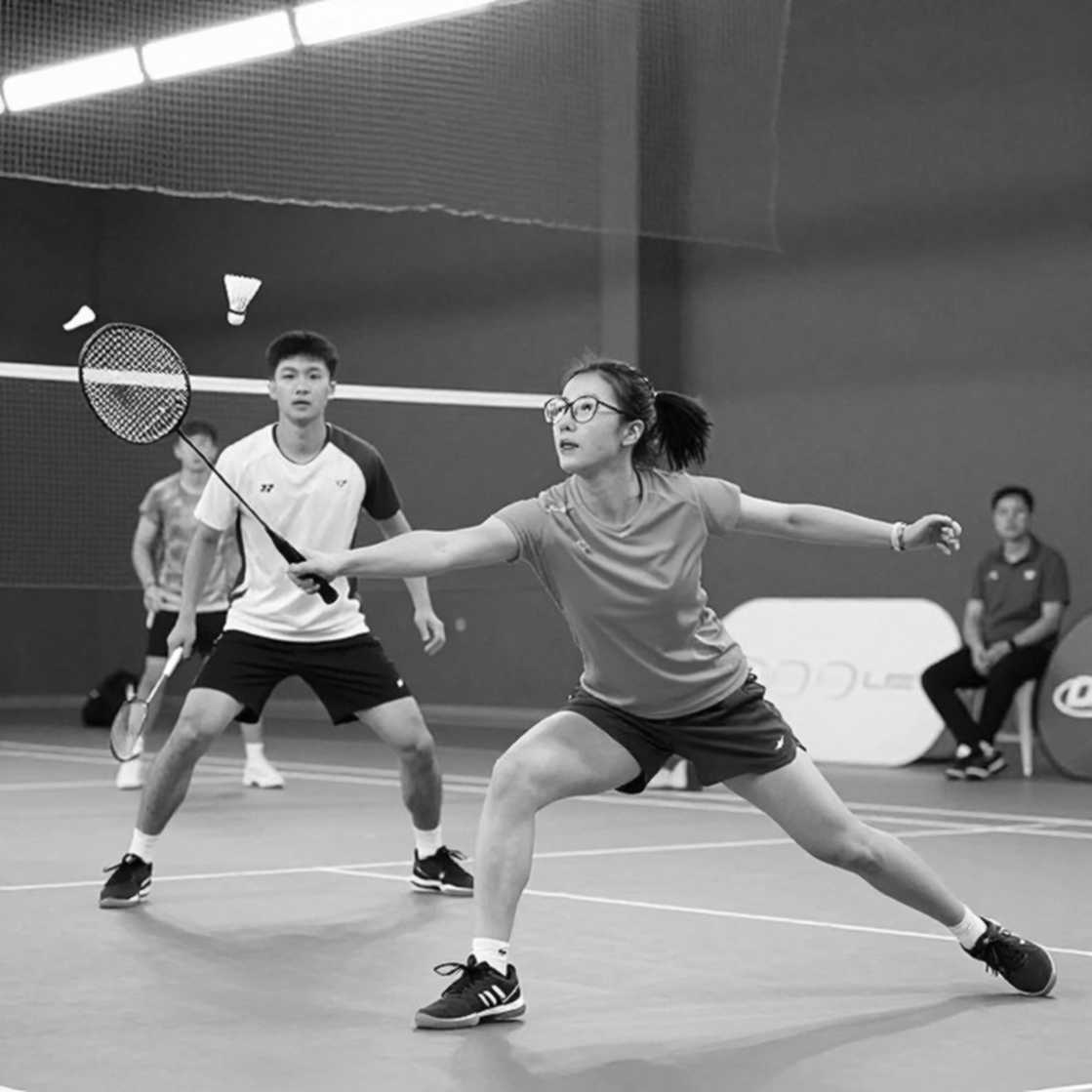
I was sitting in the seventh row of the arena, with nearly two hundred empty seats behind me. On court, the women's singles final was moving into the third game. Nobody in the stands stood up. Nobody shouted. There was only the sound of rubber soles grinding on the green mat, the racket cutting into the shuttle, and breathing.
Two and a half hours earlier, at the men's singles semifinal of the same tournament, that same row was full. There were drums, flags, and a group of fans chanting a player's name in rhythm. I do not blame them. I simply record it.
What I recorded was not the absence of spectators, but the gap between the quality of badminton being played and the number of people watching it. In that third game there were at least four changes of shuttle direction that I had to rewind three times before I trusted my own eyes. Four. On a court where nobody applauded.
People call that a small tournament. I call it one half of Vietnam's badminton court playing without a grandstand. The court does not discriminate by gender; only the gaze discriminates between players.
CONTEXT: AN ECOSYSTEM BUILT FOR SOMEONE ELSE
To understand why that gap exists, you have to understand the tournament structure Vietnamese women's badminton plays inside.
The BWF World Tour is tiered into Super 1000, Super 750, Super 500, Super 300 and Super 100. Ranking points are allocated by tournament tier and by how far a player advances. A player who wants to reach the world top 30 must keep a dense calendar all year, fly across time zones, and accumulate points at events whose prize money does not cover travel costs.
That is the arithmetic every mid-tier player faces. But for a Vietnamese woman player, the equation has an extra variable: resources.
I have tracked the competition calendars of Vietnamese women's players across several consecutive seasons. What I see is a repeating pattern: they concentrate on a handful of Asian and Southeast Asian events, add the home Vietnam Open, and then commit everything to the SEA Games. They do not have the budget to play continuously in Europe. They do not have a dedicated fitness team, a video analyst, or a travelling sports doctor. A women's player ranked around 50th in the world from another country typically has at least five people in her team. The equivalent figure for a leading Vietnamese woman player, as far as I know, is usually one.
That is the context. And that context determines almost everything that happens on court.
THE NUMBER NOBODY MENTIONS: RALLY LENGTH AND THE TRANSITION THRESHOLD
Start with the technical figure I consider most important, and also the least discussed: average rally length.
At the elite world level, a women's singles rally lasts roughly 9 to 12 seconds, with 8 to 14 shuttle contacts. But the key is not length. It is distribution. The world's leading women structure a rally almost symmetrically: two to three beats to establish position, three to four in the middle to apply pressure, and two to three at the end to finish or force an error.
When I rewatch footage of Vietnamese women's players in international events, that structure is skewed. The opening beats are good, sometimes very good. The middle is fine. But the closing beats lack one thing: decisiveness.
I want to be precise here, because this is often misread as a psychological issue. It is not psychology. It is the direct consequence of missing specialised physical conditioning.
In singles badminton there is a concept coaches call the transition threshold. It is the moment inside a rally when a player shifts from defence into attack. Among Vietnamese women's players, that threshold typically arrives one to two beats later than it does for opponents of comparable level. One to two beats. It sounds small. But inside a 10-second rally, one beat is roughly 0.8 to 1 second, and one second in women's singles is enough for an opponent to move the shuttle from one corner to the opposite one.
Why is the threshold delayed? Because transition requires a small jump with a change of direction, and that jump consumes energy exponentially if repeated hundreds of times in a match. A player with specialised conditioning makes that jump on the fourth beat. A player without it waits until the fifth or sixth, not because she does not want to, but because her body is managing an energy budget for the next game.
This is why so many matches involving Vietnamese women follow the same script: game one won or narrowly lost, game two fading, game three lost control around 12 to 15 points.
If you watch enough, you realise that script is not coincidence. It is a physiological fingerprint.
THE BRAKING STEP: THE DECISIVE SHOT IS IN THE LEGS, NOT THE RACKET
There is a common amateur belief that badminton is decided by the wrist. That is partly true, but in women's singles it misses the centre of gravity.
In women's singles, matches are decided by the legs. More precisely, by the ability to recover the central position after every shot.
I once counted during an international match involving a Vietnamese woman player. In a 21-point game lasting about 22 minutes, she made roughly 280 to 320 controlled movements. Of those, the number of times she returned to the central position before the opponent's next contact, what I call on-time recovery, was only about six in ten.
Six in ten is not bad for an amateur. But at international level, leading women's players reach about eight in ten. That two-tenths gap is precisely the distance between a top-60 player and a top-25 player.
And here is the counter-intuitive part: the problem is not running speed. Vietnamese women's players run fast. The problem is the final transition step, the one I call the braking step. It is a short step, taking under half a second, used to stop momentum and change direction. The braking step requires hamstring and glute strength, a muscle group very few badminton training programmes in Vietnam focus on.
Traditional training programmes concentrate on distance running, interval running and racket drills. That was the foundation of the previous decade. Modern women's singles has shifted to a model of repeated explosive power, meaning the ability to perform a maximum-effort movement many times in succession within short windows, interspersed with short rests. Training centres in Denmark, Japan, South Korea and China integrated this concept years ago.
In Vietnam, I have not seen a specialised physical conditioning programme for women's badminton deployed at system level. There are individual efforts. But individual efforts do not produce a generation.
READING THE MATCH: THREE REPEATING PATTERNS
Over years of note-taking, I have identified three patterns that repeat among Vietnamese women's players when they face opponents of equal or slightly higher level.
The first is winning the first beat, losing the third. Vietnamese players usually win rallies under six seconds. They have good reflexes, flexible wrists, and a very high ability to read shuttle direction at close range. But once a rally passes ten seconds, their win rate drops sharply. This tells us the technical foundation is not the problem. The physical foundation is.
The second is a fear of deep high clears. The deep high clear to the back corner is one of the most basic shots, but it is also the most energy-expensive to handle if you have no attacking option. Vietnamese women tend to push clears without depth, or to cut the shuttle down early to avoid retreating. Both choices open opportunities for the opponent.
The third is dropping points between 14 and 17. This is the zone where psychological pressure and physical pressure compound. In this zone, Vietnamese women tend to choose the safe option: hitting to the middle, pushing a clear without depth, or trying to finish too early with an underpowered smash. All three are the choices of someone conserving energy, not someone controlling the match.
These three patterns are not independent. They are three expressions of the same root cause.
NGUYEN THUY LINH AND THE CONVERSION FROM DEFENCE TO ATTACK
Nguyen Thuy Linh is the most analytically interesting case in Vietnamese women's badminton over the past decade, and the reason is not her results.
In the early phase of her international career, her game was built on resilient defence. She covered a lot of ground, saved well, and extended rallies to wait for opponents to make errors. That was a smart approach for a player without explosive conditioning, because it turned a weakness in power into an advantage in patience.
But that approach has a ceiling. The ceiling is the leading attacking women, players who do not need to wait for you to miss, but actively end rallies on the fifth or sixth beat. Against them, resilient defence only prolongs the match, it does not change the result.
What I have observed in Nguyen Thuy Linh in recent seasons is an attempt at conversion. She has increased her frequency of coming to the net, increased the number of smashes per game, and most importantly she has changed her receiving position when the opponent serves. It is a small technical change but a large tactical one, because it signals intent to attack from the opening beat rather than to wait.
The problem is that this conversion cannot be completed without matching physical support. A player moving from defence to attack requires her body to spend roughly 20 to 30 percent more energy per game. If the physical foundation is not raised at the same time, you get an attacking player in game one and an exhausted defensive player in game three.
That is the paradox I call the paradox of the self-converting player. You can see the right direction. You do not have the means to walk the whole road.
THE VU THI TRANG GENERATION AND THE PRICE OF PIONEERING
Vu Thi Trang belongs to the pioneering generation. She was one of the first Vietnamese women to earn an Olympic place in women's singles, and that means she had to build the road others now walk on.
I want to speak plainly about the price of pioneering, because it is often turned into an inspirational story.
Pioneers have no precedent to reference. They do not know how many flights a BWF World Tour season requires, how many hotel nights, how many recovery sessions. They do not know whether to choose a Super 300 or a Super 500 when the budget covers only one. They learn by paying: with qualifying-round defeats, with small injuries accumulating into large ones.
What the next generation inherits is not only tournament entries. It is operational knowledge. Knowing to book flights three months early to cut costs. Knowing which events yield points most efficiently. Knowing that a qualifying loss at a Super 300 is still better than a month of training at home with no competition.
That is the real legacy of a pioneering generation. And it does not appear on a results sheet.
WOMEN'S DOUBLES: A FORGOTTEN HALF INSIDE A FORGOTTEN HALF
If Vietnamese women's singles gets little attention, women's doubles is almost invisible.
This bothers me most when I look at the whole picture. Women's doubles demands the highest level of coordination in badminton, higher than men's doubles, because rally speed in women's doubles is typically one beat slower than in men's doubles. That means more time to make decisions, which means tactical coordination becomes the decisive factor rather than raw power.
In women's doubles there are three basic defensive shapes: parallel defence, rotational defence, and diagonal defence. Each shape requires its own communication convention between the two players. Leading women's pairs switch between these shapes mid-rally with almost no visible signal. That can only be built through thousands of hours playing with the same partner.
The problem for Vietnamese women's doubles is exactly here: they change partners frequently. Every tournament, a new pairing. And every time the pairing changes, the entire communication convention has to be rebuilt from zero.
I do not have official data on how many times Vietnamese women's pairs change partners in a season. But my tracking suggests that figure is far higher than for women's pairs from Thailand, Indonesia, Japan or South Korea, where a pair typically stays together for years.
This is a textbook example of Vietnamese women's badminton being organised in a way that is not optimal for itself.
REGIONAL COMPARISON: WHY THAILAND MOVED AHEAD
Thailand is the most useful comparison, because its population is comparable and its badminton starting point in the 1990s was not radically different.
Thailand did three things differently.
First, it built a continuous junior system. A Thai woman player competes internationally at youth level from age 14, and by 18 has competed on at least three continents.
Second, it invested in badminton-specific physical conditioning from youth level, not only at national-team level. This is the crux. If you start building explosive conditioning at 22, you have lost six years.
Third, and perhaps most important: Thai women's badminton has a domestic market. Women's matches are televised, have their own sponsors, and draw paying spectators. That creates positive pressure for women players to become fully professional rather than semi-professional.
Vietnam does not yet have the third. And without the third, the first two are hard to sustain, because there is no revenue to reinvest.
ANOTHER HALF: WOMEN'S FOOTBALL AND THE HALF PITCH
I wrote about women's football for years before turning to badminton. In 2026, when the whole country was watching Moscow, I stayed behind and recorded a figure: Vietnamese television broadcast thousands of hours of men's football in a year, but devoted only a few minutes to women's football.
That was when I named my platform Half a Pitch. A Half of the World is what I call the part that gets forgotten.
Years later, sitting in the seventh row of a badminton arena with two hundred empty seats behind me, I realised the problem had not changed. It had only changed sports.
For three weeks I heard the grass grow, and nobody kicked it. I wrote that line during the pandemic, when every tournament froze and my platform's revenue fell nearly 80 percent in three months. I locked the door, stopped answering messages, and rewatched old match footage. And I learned something: an empty court is not a dead court. An empty court is a court where nobody has turned the lights on yet.
THE COUNTER-INTUITIVE VIEW: THE PROBLEM IS NOT THE COURT, IT IS THE CAMERA OPERATOR
Now I have to say what many people in the industry do not want to hear.
If the problem of Vietnamese women's badminton were only fitness and budget, it would be a technical problem, and technical problems have solutions. But the bigger problem lies elsewhere: Vietnamese women's badminton is being judged against a frame of reference designed for men's badminton.
Here is how it works. When a men's singles match is played, the media focuses on the smash. The smash is fast, powerful, decisive, it creates a moment. When a women's singles match is played, its greatest value usually is not the smash but the rally sequence. That is the art of movement, of reading intent, of changing tempo. But a rally sequence does not produce a three-second clip that spreads.
And because there is no spreading clip, there is no audience. And because there is no audience, there is no sponsor. And because there is no sponsor, there is no fitness budget. And because there is no fitness budget, the transition threshold is delayed by one beat. And because the threshold is delayed by one beat, the third game is lost around 14 points.
That is a loop. And the loop begins with how people film, not with how people play.
I once worked in a newsroom. I know how an editor picks stories: whatever has strong images goes first. That is not malice. That is operating logic. But that operating logic is producing a consequence nobody in the newsroom calculates: it re-prices the value of a sport based on its ability to produce images, rather than on the quality of its competition.
Leaving is one way of finding your own half. In 2026 I left the newsroom after twelve years. Not because I was tired of the job. Because I wanted to write about the forgotten half in a way the newsroom would not allow. Leaving the newsroom is not leaving the profession; it is leaving the desk to follow your own whistle.
For Vietnamese women's badminton, that half is the same. It is not abroad. It is right here on home courts, only nobody has turned on the lights.
AN EQUIVALENT SAVE
In 2026 I flew to Tokyo to follow the Vietnamese women's national team at their first Olympic appearance. They lost all three group matches. Many people called it a failure.
But the moment I remember most is not a goal or a scoreline. It is a sequence of saves by a goalkeeper in a match whose outcome was already decided. Those saves did not change the standings. But they proved one thing: the gap between a Vietnamese women's team and a top world team is not in ability, it is in resources.
I always look for moments like that in women's badminton. A rally on the seventh beat where the player still has the strength to jump and smash. A retreat to the back corner where she still recovers in time. A decision to change direction at 18-all.
Those moments are real. They are just not filmed close enough.
WHAT I WANT TO SEE
Something is changing, and I want to record it before it is forgotten.
The number of Vietnamese women competing on the BWF World Tour is rising. Not dramatically. But rising. And more importantly, some young players are beginning to compete at Super 100 and Super 300 level more regularly than the previous generation. That means they are accumulating international experience, something money cannot buy if you never get on court.
This is where I read the common assumption backwards. Many people say qualifying rounds are a hurdle. For a Vietnamese woman player, qualifying is an opportunity. A qualifying loss at a Super 300 still gives a young player something more important than ranking points: data. Data on the real speed of international opponents, the real tempo of a world-level match, the real distance between the training hall and the arena.
I have stood inside that arena. I know how large that distance is.
People call it leaving; I call it finding my own half of the pitch. And in women's badminton, the most notable act of leaving in the coming years may be leaving old organisational habits: leaving the constant changing of partners, leaving outdated conditioning programmes, leaving one player to handle everything alone.
What I want to see in the coming years is not a medal. It is a team. Three people. A fitness coach, a video analyst, and a sports doctor. Those three travelling with one woman player through a season. If that happens, the transition threshold shifts one beat earlier. And one beat, as I said, is a whole match.
The question I leave behind is not when Vietnamese women's badminton will win a world medal. It is this: when a Vietnamese woman player steps into a third game at 18-all, who will be standing behind her?

Cầu thủ liên quan
Bài đề xuất
China Masters 2026: Srikanth, Satwik-Chirag and the Diagnostic Chart Behind a Quarter-Final Ticket2026-09-13
China Lowers Its 2026 Asian Games Target: The Two-Gold Plan and the Gaps Left Unfilled2026-09-18
Aidil Sholeh creates Malaysian history at Vietnam Open 2026: The win is real, but the scale is...2026-09-14
Srikanth at 33, Satwik-Chirag's 69 minutes: What the China Masters 2026 scoreboard is telling us?2026-09-08
Asian Games 2026: India Brings 20 Badminton Players, But One Doubles Pair Holds the Gold Medal Fate2026-09-13
World Badminton After Paris 2026: When Space Decides More Than Power2026-09-13
Bài đề xuất
The Top Seed's Chair: Ashmita Chaliha, the Haze, and the Data Void at the Bottom Tier of the BWF World Tour2026-09-15
Half a Badminton Court: Nguyen Thuy Linh, Vu Thi Trang and the Race Without a Grandstand2026-09-16
Aidil Sholeh and the Super 100 Title: Malaysian History Written from Outside the System2026-09-14
World Badminton After Paris 2026: When Space Decides More Than Power2026-09-13
The Last-Meter Gap and the Geometry of Collapse: Nguyen Thuy Linh Falls to Xu Wen Jing at the Vietnam Open2026-09-16
Bài đề xuất
Vietnamese Table Tennis: Journey to Continental Stage and the Sustainable Development Equation2026-09-13
Tien Minh Wins All-Vietnamese Qualifier, Still Burning with Desire at 432026-09-09
Aidil Sholeh creates Malaysian history at Vietnam Open 20262026-09-14
Two Gold Medals and a Data Void: What Is Really Happening Inside China's Badminton Team Ahead of the 2026 Asian Games2026-09-18
Tanvi Patri Wins the U17 Asian Title in Chengdu: Reading Back Thirteen Games and the Gaps in the Data2026-09-14
Alwi Farhan Spars With Momota Before Asian Games 2026: Rally Tolerance Is Worth More Than Any Photo2026-09-18