
Brazil win 16th straight South American title: the Olympic spot and the stat lines nobody read to the end
**Câu trả lời cốt lõi**: Brazil giành chức vô địch bóng chuyền nữ Nam Mỹ lần thứ 24 trong lịch sử và lần thứ 16 liên tiếp, thắng Argentina 3-0 (26-24, 25-19, 25-16) tại Maracanãzinho, Rio de Janeiro. Đội thắng cả năm trận không thua set nào. Việc giành suất dự Olympic Los Angeles 2028 qua ngôi vô địch châu lục cần được đối chiếu với quy định vòng loại của FIVB. **Dữ kiện chính**: - Brazil thắng Argentina 3-0 (26-24, 25-19, 25-16) trong trận chung kết bóng chuyền nữ Nam Mỹ tại Maracanãzinho. - Gabriela Guimarães ghi 13 điểm (10 tấn công, 2 ace, 1 chắn), cao nhất đội Brazil. - Julia Bergmann vào từ ghế dự bị ghi 12 điểm; Tainara Santos ghi 11 điểm và điểm quyết định. - Brazil vô địch Nam Mỹ lần thứ 24 và lần thứ 16 liên tiếp, thắng cả 5 trận không thua set. - Rosamaria Montibeller được báo chấn thương, mở đường cho Tainara Santos ở vị trí đối chuyền. **Nguồn**: Bản tin giải vô địch bóng chuyền nữ Nam Mỹ (CSV), năm 2026; các số liệu cá nhân chưa được đối chiếu bảng điểm chính thức của CSV hoặc Volleyball World | Cross-checked: VuaBong.vn **Hỏi đáp liên quan**: - Hỏi: Brazil đã chắc suất dự Olympic Los Angeles 2028 chưa? Đáp: Theo bản tin, Brazil giành suất qua chức vô địch châu lục, nhưng cơ chế này cần đối chiếu quy định vòng loại LA 2028 của FIVB. - Hỏi: Ai ghi điểm nhiều nhất trong trận chung kết? Đáp: Gabriela Guimarães với 13 điểm, theo sau là Julia Bergmann 12 điểm và Tainara Santos 11 điểm. - Hỏi: Rosamaria Montibeller có thi đấu trận chung kết không? Đáp: Rosamaria được báo chấn thương, Tainara Santos đảm nhiệm vị trí đối chuyền thay cô.
The first set ended 26-24. It was the only set of the South American women's volleyball final that Argentina could drag to the final points. The next two went by at 25-19 and 25-16, quickly enough that the Maracanãzinho stands barely had time to change their rhythm. I stayed in my seat after the final whistle and wrote three numbers in my notebook: 13, 12, 11.
Three hitters, three scoring totals, none far ahead of the others. A final is usually remembered by the name of the player who scores the decisive point. I remember this one for the way it was shared out.
Maracanãzinho in Rio de Janeiro, an arena that has witnessed historic men's volleyball nights, spent the week hosting the women's game. Brazil entered as hosts and left with their 24th South American title and their 16th in a row. Five matches, fifteen sets, none dropped. Argentina — the only other unbeaten side going into the last day — was the final opponent, and the only one to force Brazil to 26 points.
The tournament ran across roughly a week, five matches for Brazil in about six days. That density sounds heavy, but because Brazil won all five in straight sets, their actual time on court was far shorter than a team forced to five sets every night. A single-venue round robin ending in a decider between the two unbeaten teams created a de facto knockout on the final day, and Brazil benefited from that structure more than anyone.
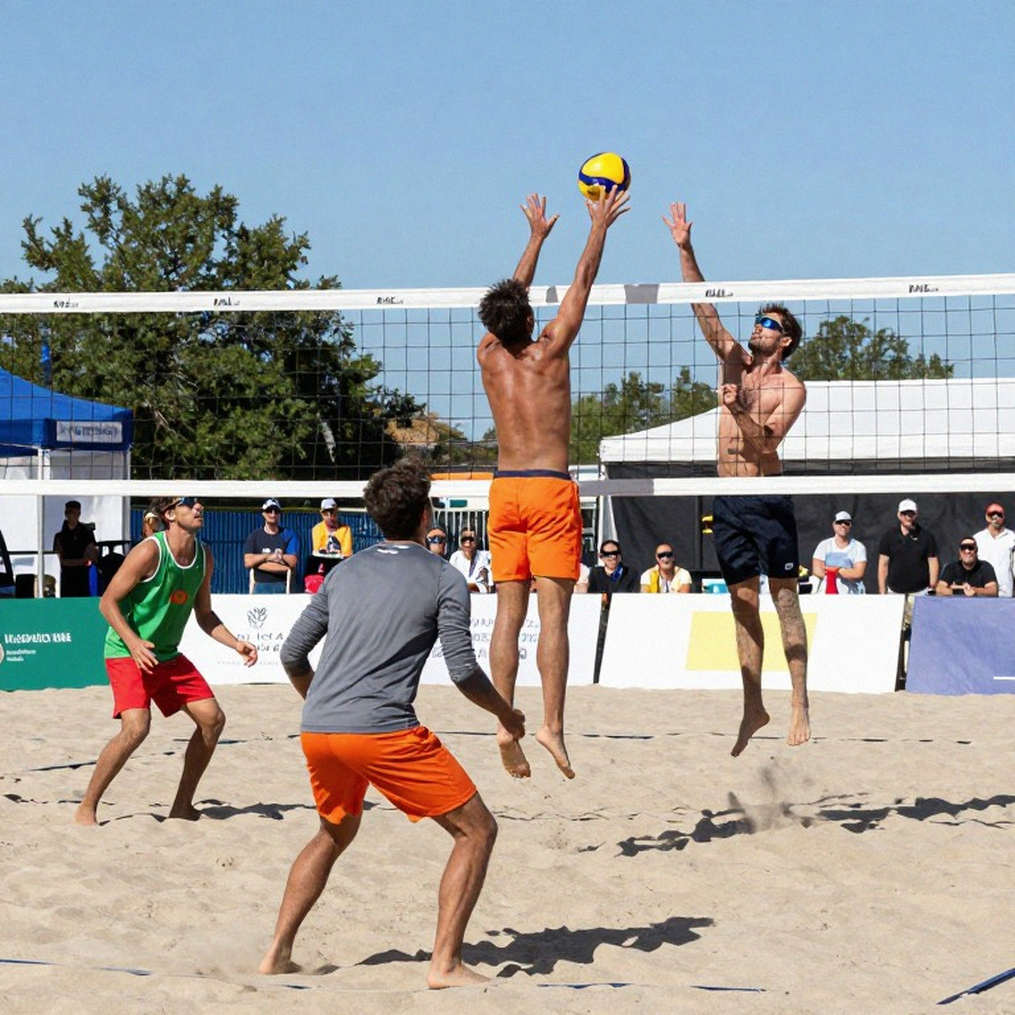
The annual South American women's season rarely travels beyond the continent. Rewatching the footage, what stood out to me was not the scoreline. It was that Brazil's lineup no longer resembled the one I had been logging in the previous qualifying cycle.
Rosamaria Montibeller, the starting opposite, was reported injured. Her slot went to Tainara Santos. And on the bench, Julia Bergmann waited. Three names, three different roles, walking into a match Brazil could not afford to lose.
This is where I took out the notebook and counted. Gabriela Guimarães — the captain, back after missing the VNL — scored 13 points: 10 kills, 2 aces, 1 block. Julia Bergmann, off the bench, scored 12: 11 kills, 1 block. Tainara Santos, replacing Rosamaria at opposite, scored 11: 10 kills, 1 block, and the match-winning point itself.
Together the three accounted for 36 points. A 3-0 win requires a minimum of 75 points to close three sets, meaning the rest spread across the middles and the remainder of the roster. No hitter reached 15. No hitter was over-relied upon.
The most notable thing about this final is not the title — it is that Brazil won without a single hitter carrying the load.
In modern women's volleyball, the dominant model at the top is to funnel the ball to one lead opposite: a player who carries 20 to 25 points a night, and whose shut-down collapses the entire attack. Brazil went the other way here: three attacking lanes, three similar totals, none an absolute anchor. That is a healthy structural signal, at least on the surface of the data.
But this is where I have to stop and be explicit about my own method. Those figures have not been cross-checked against an official CSV or Volleyball World box score. There is no attack efficiency, no reception percentage, no block total. I only have individual point totals from a single match.
Individual point totals, in volleyball, are a politely dishonest metric. Ten kills can come from 15 swings at a spectacular efficiency, or from 35 swings at an average one. Without a denominator, the numerator says nothing. Based on my experience following these matches across many seasons, when a report gives points but not efficiency, I read it as a result notice, not a performance assessment.
So where does the performance assessment live?
It lives in the first set. Argentina pushed the match to 24-24 before losing it 26-24. That suggests Argentine serving and blocking disrupted Brazil's reception early, enough that Brazil could not separate. Then Brazil adjusted, and the next two sets finished 25-19 and 25-16. A well-coached team does not have to lead from the start; it only has to read the match before it ends. Brazil read it after one set.
I do not know exactly what they adjusted, because there is no data to say. But the curve from 26-24 to 25-19 to 25-16 is a familiar one: the weaker opponent empties everything it has into the first set, falls short, and has nothing left to throw.
And this is where the story shifts to the part I care about most.
Brazil's second- and third-highest scorers — Bergmann and Tainara — were both outside the expected starting six. One came off the bench. One replaced an injured teammate. Both cleared 10 points in a final.
I do not only tell the match; I tell the people ranked below the scoreline. Every report on this title will name Gabi Guimarães first — and rightly so, as a captain returning from a break. But this final was decided by players a skimming reader might pass over.
What does that say about Brazil? It says this team has depth at opposite and outside hitter, at least at continental level. Losing a starting opposite did not collapse the system. Inserting a bench hitter preserved the scoring rhythm. That is what many national teams dream of having and usually do not.
But I have to be careful here, because there is an easy trap to fall into.
Brazil's South American title is a measure of dominance, not of world-level readiness. Brazil have won South America 16 times in a row. Their real peers are not Argentina but Italy, Serbia, the United States, Türkiye — teams for whom a 26-24 set against Argentina means nothing.
A side that wins five matches without dropping a set against sub-tier opposition can look immaculate in the data and crack in the fourth set against a European team. That does not make this title meaningless. It means every positive indicator from this tournament needs to be discounted when projected onto the world stage. I have seen enough continental hegemonies pushed to a fifth set at a world event by a taller block to stop trusting pretty numbers.
Here is the familiar paradox. The commercial value of this tournament to Brazil is low — a title they had already won 15 times running generates no sellable story. But its competitive value, inside a rebuilding cycle, is far higher than it appears. Bergmann and Tainara did not need a continental event to become known, but they needed a final to prove they can carry the pressure of a final. Commercial value and competitive value point in opposite directions here, which is why I distrust reports that only look at the trophy.
And there is one fact in the report I read over and over more than any other.
The report states Brazil sealed qualification for the Los Angeles 2028 Olympics through this continental title.
That is a claim with enormous weight, and I am not certain it is accurate as worded. Under the Paris 2026 qualification pathway, continental championships did not directly grant Olympic berths. Berths came from Olympic Qualifying Tournaments and the world ranking, with some guaranteed continental representation. If the LA 2028 pathway keeps that structure, then the phrase "sealed qualification" in the report is an overstatement, and Brazil's actual status depends on later events.
There are two possibilities. One: FIVB changed the rules and granted a direct berth to continental champions for the LA 2028 cycle — in which case the report is correct but omits the regulatory detail. Two: the report overreached, and the berth is not yet in Brazil's hands.
When every microphone points one way, I choose to stand in the gap. The gap here is the qualification regulation the report does not mention. I do not have enough facts to conclude whether Brazil have secured the spot. I only know this is the single most important item in the whole story, and it has been left blank.
One thing I am more certain of. If the berth is real, Brazil will be among the first nations to secure LA 2028, with an unusually long preparation runway — no small advantage in a four-year cycle of ever-denser calendars. If it is not real, then the Brazil story from this tournament is a team rebuilding its roster and still winning, not a team that has finished the job.
At men's World Cups, I count women appearing — fewer than the number of goals. At this South American women's championship, I counted the opposite: a tournament where women hitters were the protagonists, where a bench hitter scored 12 in a final, where a replacement opposite scored the winner. The attention is still scarce. The quality does not need that attention to exist.
As for Rosamaria — her injury is the most notable personnel item in the report, and it remains unresolved. If it is serious, Brazil enter the LA 2028 cycle with the opposite position dependent on Tainara, who has proven herself against South American opposition, not against Italy or Serbia. If it is minor, this was simply a successful, unplanned depth test. The gap between those two scenarios is enormous, and the report gives me no basis to choose a side.
What I took from the last page of the notebook is not a conclusion about Brazil. It is a question about how we read women's sport. Brazil have won 24 South American titles. The 24th is no longer news in the ordinary sense; it is habit. But inside that habit are things worth recording: a captain returning, a bench hitter stepping up, a replacement opposite closing the match. Those details only surface if the reader is willing to stop at the third line of the box score.
And if the new rule really does grant continental champions a direct berth, tournaments like this one stop being ceremony. They become gateways. On that day, an Olympic ticket could come from a match most of the audience never watched. That might be the best thing to happen to women's volleyball in years.